


Piedmont Warehousing & Manufacturing Support: A woman-owned, full-service warehousing and manufacturing support company exceeding expectations since 1975
Amazon FBA fee increases landed twice this year, and sellers have spent months arguing about pennies. Meanwhile the real number moved somewhere else entirely — and it moved a lot further than Amazon’s fees did.
The Two Amazon FBA Fee Increases of 2026
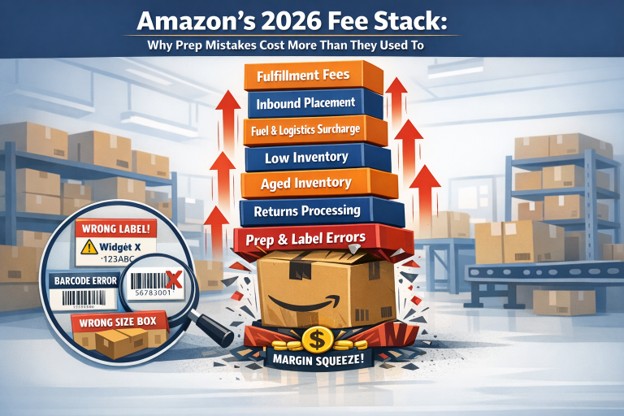
The first arrived January 15: an average increase of $0.08 per unit sold, which Amazon framed as less than 0.5% of a typical item’s selling price and well below inflation. We covered that change and the prep policy it accompanied in Amazon Ended FBA Prep. Six Months In, Sellers Are Still Paying for It.
The second was larger. Effective April 17, Amazon applied a 3.5% fuel and logistics-related surcharge to fulfillment fees across FBA in the US and Canada, extending it to Buy with Prime and Multi-Channel Fulfillment on May 2. The company put the average impact at $0.17 per unit for US FBA, calculated on fulfillment fees rather than sale price, and described the measure as temporary.
Stack the two averages and you’re roughly $0.25 per unit above where you sat in 2025. On ten thousand units a month, that’s $2,500. Real money — but not the story.
The Number Amazon Didn’t Cause
Here is what happened to diesel over the same window, according to the U.S. Energy Information Administration’s weekly retail price series:
- Week ending January 5, 2026: $3.477 per gallon
- Week ending March 2: $3.897
- Week ending March 9: $4.859 — a jump of nearly a dollar in seven days
- Week ending April 6: $5.643
That’s a 62% increase in roughly three months. Amazon’s response was 3.5%.
Read that comparison honestly and it cuts against the seller consensus. Amazon absorbed the overwhelming majority of a fuel shock and passed along a sliver. Whatever else is true about FBA economics, the April surcharge was not opportunism.
So Where Did Your Cost Actually Go?
Into the freight Amazon doesn’t charge you for.
The 3.5% applies to Amazon’s fulfillment fee — the outbound leg, from fulfillment center to customer. Your inbound leg, from your supplier or warehouse into Amazon’s network, is your own line item. Nobody absorbed that one for you. It tracks diesel at close to full pass-through, and diesel is up 62%.
Which means the cost of shipping a box into FBA rose several times faster this year than the cost of Amazon shipping it out.
Why a Rejected Shipment Now Costs Double
This is where prep accuracy stopped being a compliance question and became a freight question.
A shipment that arrives incorrectly labeled or improperly prepped doesn’t just get fixed. It gets returned, reworked, and re-sent — and both freight legs now price at elevated diesel. You paid the inbound cost once to get it wrong, and you pay it again to get it right. In 2025 that mistake cost you an inconvenience. In 2026 it costs you two freight legs at 62% above January.
The compounding gets worse. Since January 1, Amazon no longer prepares or labels units at all, so there’s no longer an option to pay Amazon to fix it on arrival. And since March 31, resellers must apply an FNSKU to every unit — more labeling steps, more chances to get one wrong — a change we cover in The FNSKU Mandate: What Ending Commingling Really Cost Resellers.
More required labeling, no safety net, and freight priced at a premium. Those three things arrived within ninety days of each other.
About That Word “Temporary”
Amazon said it would keep evaluating the surcharge as conditions evolve. Conditions have partly evolved: EIA’s series shows diesel easing from the April peak to $5.350 in the week ending June 1 — still roughly 54% above where the year started.
Sellers in Amazon’s own forum thread responded to the announcement with open skepticism about whether any surcharge described as temporary ever gets removed. That’s a prediction, not a fact, and we won’t make it here. What is a fact: fuel has not returned to January levels, and neither has your inbound freight cost.
The Practical Read
You can’t control diesel. You can’t control Amazon’s fee schedule. You can control how many of your shipments need a second freight leg — and in a year when that second leg costs what it costs, getting prep right the first time is a margin lever rather than a housekeeping task. Where you prep matters too, which we take up in Prep Moved South: Placement Fees, Cross-Docks, and the I-85 Advantage.
Frequently Asked Questions
What were the Amazon FBA fee increases in 2026?
Two. An average increase of $0.08 per unit sold effective January 15, and a 3.5% fuel and logistics-related surcharge on fulfillment fees effective April 17, which Amazon estimates at roughly $0.17 per unit for US FBA.
Does the 3.5% surcharge apply to my sale price?
No. Amazon calculates it on your fulfillment fees, not on the sale price of your items. It also does not apply to referral fees or storage fees.
When did the surcharge hit Multi-Channel Fulfillment?
May 2, 2026, along with Buy with Prime in the US. FBA in the US and Canada started April 17.
Is the fuel surcharge permanent?
Amazon described it as temporary and said it will continue evaluating as conditions evolve. No end date has been announced.
Why does prep accuracy affect my costs more in 2026 than before?
A rejected shipment requires a return leg and a re-send. Both legs are priced against diesel, which EIA data shows rose roughly 62% between early January and early April 2026. The same mistake simply costs more freight than it did last year.
About the Author
Ada Wallace is President of Piedmont Storage and Repack, LLC, operating as Piedmont Warehousing & Manufacturing Support in Spartanburg, South Carolina. She brings more than 24 years in the warehousing and manufacturing support industries and leads the second generation of Wallace family ownership of a business founded in 1975. Under her leadership, Piedmont holds ISO 9001:2015 certification and Women’s Business Enterprise (WBE) designation, serving clients across Spartanburg, Greenville, Anderson, Cherokee, Laurens, and Union counties. She can be reached at awallace@piedmontwarehousing.com.
Piedmont Warehousing & Manufacturing Support
Piedmont has run warehousing and manufacturing support from Spartanburg, South Carolina since 1975. The operation is ISO 9001:2015 certified, woman-owned, and built around getting shipments right on the first freight leg.
Our Services Include:
- Amazon Prep Services — FNSKU labeling, poly bagging, date labels, kitting, and shipment builds to Amazon’s current spec
- Warehousing Services — Short- and long-term storage under the same roof as prep, eliminating a freight leg entirely
Re-running your unit economics? Contact Piedmont to talk through your volume and turnaround needs.
Works Cited
“Fuel and Logistics-Related Surcharge: FBA, MCF, and BWP in US and CA.” Amazon Seller Central News and Announcements, Amazon.com Services LLC, sellercentral.amazon.com/seller-forums/discussions/t/7cbc0233-ee5b-4359-978a-dee7cad5c6f4. Accessed 16 July 2026.
“Weekly U.S. No 2 Diesel Retail Prices (Dollars per Gallon).” U.S. Energy Information Administration, U.S. Department of Energy, 2 June 2026, www.eia.gov/dnav/pet/hist/LeafHandler.ashx?n=pet&s=emd_epd2d_pte_nus_dpg&