


Piedmont Warehousing & Manufacturing Support: A woman-owned, full-service warehousing and manufacturing support company exceeding expectations since 1975
On March 31, 2026, Amazon split FBA into two classes of seller. Brand owners got a $600 million gift. Everyone else got a permanent new line item. The FNSKU labeling requirements that took effect that day drew the line — and which side you landed on had nothing to do with how well you run your business.
What Amazon Actually Changed
Commingling was Amazon’s practice of filling an order with the closest matching unit in the network, regardless of which seller sent it in. Two sellers shipping the same UPC went into the same pool. Amazon announced the end of the practice and set out three rules for inventory shipped on or after March 31:
- Brand owners with the Brand Representative selling role in Brand Registry no longer need Amazon barcode stickers on products that already carry a manufacturer barcode such as a UPC or ISBN.
- Resellers not enrolled as a Brand Representative must now use Amazon barcode stickers — even when the product has a perfectly good manufacturer barcode printed on it.
- Products with no manufacturer barcode still require Amazon stickers from everyone.
Note the trigger. It’s the ship date, not the arrival date and not the date you built the shipping plan. Several secondary write-ups got this wrong in the run-up to the deadline.
Why Commingling Had to Go
Amazon’s stated reasoning is that most sellers now keep inventory close enough to customers that fast delivery no longer requires pooling. That’s the operational answer.
The reputational answer is older. Pooling meant a customer ordering from a careful seller could receive a unit sent in by a careless one, and brands had no way to trace a bad unit back to whoever shipped it. The scale of that problem is documented: the U.S. Government Accountability Office bought 47 brand-name items from third-party sellers across five major e-commerce sites and found that rights holders identified 20 of them as counterfeit — including all 13 cosmetics purchased. That 2018 study predates this policy by years, but it explains why brand owners spent a decade paying to sticker their way out of the pool.
Ending commingling fixes that. It just fixes it by moving the cost, not removing it.
The $600 Million Nobody Mentions Is a Transfer
Amazon estimates the move to stickerless inventory management will save sellers roughly $600 million annually, while giving them more flexibility to manage inventory across sales channels.
That figure is real, and it’s worth reading closely. The savings accrue to brand owners who can now skip a labeling step they previously paid for. Resellers are on the other side of the ledger: they gained a labeling step they previously could skip. Amazon didn’t publish a number for that side.
Who Actually Got Reclassified
The dividing line is the Brand Representative role — not size, not volume, not tenure. Wholesale sellers, distributors, arbitrage sellers, and private-label sellers who never enrolled in Brand Registry all landed in the same bucket, however different their operations look.
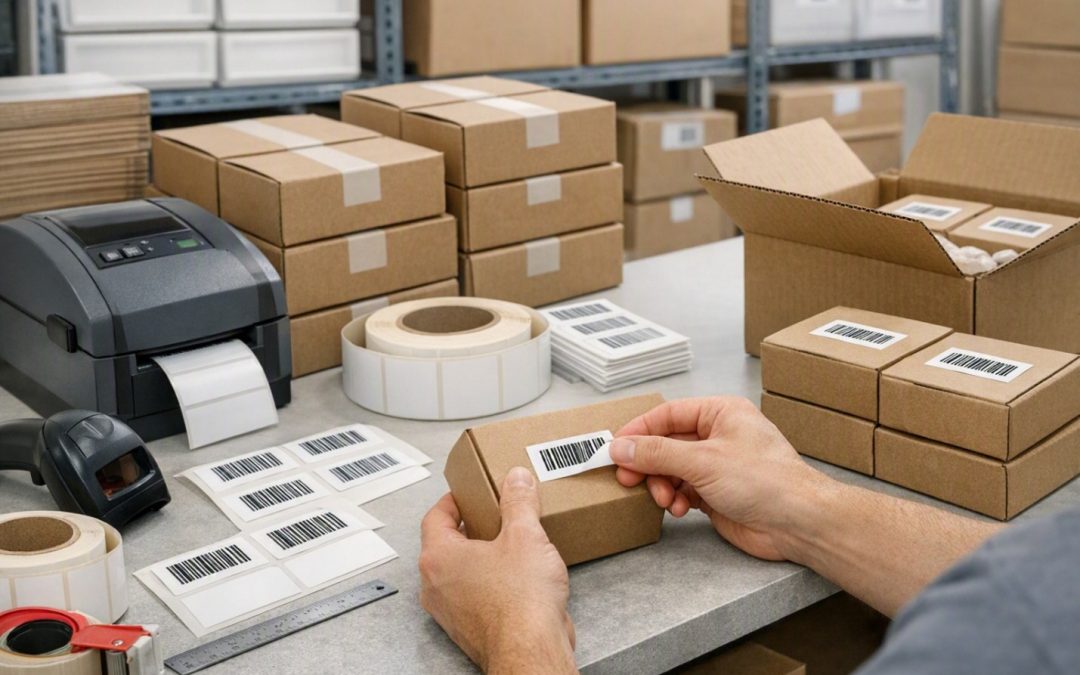
Every unit now needs an FNSKU applied before it ships. For a seller moving a few hundred units a month, that’s an evening. For one moving tens of thousands across dozens of SKUs, it’s a staffing decision — one arriving right as Amazon exited the prep business, a sequence we covered in Amazon Ended FBA Prep. Six Months In, Sellers Are Still Paying for It.
The two changes compound. Amazon stopped labeling units on January 1. It required more units to be labeled on March 31. Sellers who once paid Amazon to sticker their inventory can no longer buy that service at any price.
The Part That Isn’t Optional
Brand Registry enrollment is the obvious escape, and for genuine brand owners it’s worth doing. But the Brand Representative role requires an active registered trademark on a brand you own. A wholesaler reselling someone else’s products cannot enroll their way out of this. Neither can an arbitrage seller. For most resellers, FNSKU labeling is now simply a permanent part of the cost of goods.
Which makes it a math problem rather than a compliance problem. The question isn’t whether to label — it’s whether labeling in-house, at the supplier, or at a 3PL costs less per unit at your volume. That calculation shifted again with this year’s fee changes, which we break down in Amazon’s 2026 Fee Stack: Why Prep Mistakes Cost More Than They Used To. Where the labeling happens matters too, as we cover in Prep Moved South: Placement Fees, Cross-Docks, and the I-85 Advantage.
Frequently Asked Questions
What are the FNSKU labeling requirements as of March 31, 2026?
Resellers not enrolled in Amazon Brand Registry with the Brand Representative selling role must apply Amazon barcode stickers to every unit, even when the product already carries a manufacturer barcode. This applies to inventory shipped on or after March 31, 2026.
Can brand owners stop using FNSKU labels entirely?
Brand owners with the Brand Representative selling role no longer need Amazon barcode stickers to prevent commingling on products that already have a manufacturer barcode such as a UPC or ISBN. Products without a manufacturer barcode still require Amazon stickers.
Does the deadline apply to when I create the shipment or when it arrives?
Neither. Amazon’s requirements apply to inventory shipped on or after March 31, 2026.
I’m an authorized reseller in Brand Registry. Am I exempt?
Amazon’s policy ties the exemption specifically to the Brand Representative selling role. Enrollment in Brand Registry alone is not the qualifying condition. Confirm your role in Seller Central rather than assuming.
Why did Amazon end commingling?
Amazon’s stated reason is that most sellers now maintain inventory levels close enough to customers that fast delivery no longer requires pooling units across sellers.
About the Author
Ada Wallace is President of Piedmont Storage and Repack, LLC, operating as Piedmont Warehousing & Manufacturing Support in Spartanburg, South Carolina. She brings more than 24 years in the warehousing and manufacturing support industries and leads the second generation of Wallace family ownership of a business founded in 1975. Under her leadership, Piedmont holds ISO 9001:2015 certification and Women’s Business Enterprise (WBE) designation, serving clients across Spartanburg, Greenville, Anderson, Cherokee, Laurens, and Union counties. She can be reached at awallace@piedmontwarehousing.com.
Piedmont Warehousing & Manufacturing Support
Piedmont has run warehousing and manufacturing support from Spartanburg, South Carolina since 1975. The operation is ISO 9001:2015 certified, woman-owned, and handles per-unit labeling at volume for sellers who can’t absorb it in-house.
Our Services Include:
- Amazon Prep Services — FNSKU labeling, poly bagging, date labels, kitting, and shipment builds to Amazon’s current spec
- Warehousing Services — Short- and long-term storage under the same roof as labeling, with no extra freight leg
Running the per-unit math? Contact Piedmont to talk through your SKU count and volume.
Works Cited
“Commingling Practices Will End Effective March 31, 2026.” Amazon Seller Central News and Announcements, Amazon.com Services LLC, sellercentral.amazon.com/seller-forums/discussions/t/106d0747-e5c6-44d8-86f3-7669f11238fe. Accessed 16 July 2026.
“Amazon Accelerate 2025: A New Era of Tools and Technology for Independent Sellers.” Amazon Selling Partners, Amazon.com, 18 Sept. 2025, sellingpartners.aboutamazon.com/amazon-accelerate-2025-a-new-era-of-tools-and-technology-for-independent-sellers. Accessed 16 July 2026.
Intellectual Property: Agencies Can Improve Efforts to Address Risks Posed by Changing Counterfeits Market. GAO-18-216, U.S. Government Accountability Office, 30 Jan. 2018, www.gao.gov/products/gao-18-216. Accessed 16 July 2026.