


Piedmont Warehousing & Manufacturing Support: A woman-owned, full-service warehousing and manufacturing support company exceeding expectations since 1975
Most sellers treat Amazon inbound placement fees as weather — something that happens to them. It isn’t. It’s a menu, and the option you pick is largely decided months earlier, by where your inventory sits before it ever moves.
How Amazon Inbound Placement Fees Actually Work
The FBA inbound placement service fee prices a tradeoff. Ship everything to one location and Amazon distributes it across the network for you — convenient, and the most expensive option per unit. Spread the same inventory across more receiving locations yourself and the fee drops, in some cases to nothing.
Rates vary by size tier, weight, and which locations you’re shipping into, and Amazon adjusts them. Check the current schedule in Seller Central against your own ASINs rather than trusting any number you read in a blog post — including this one.
What matters isn’t the exact figure. It’s the shape: Amazon charges you for convenience and pays you back for distribution.
The Lever Amazon Named Out Loud
This isn’t a loophole. In its 2026 fee announcement, Amazon told sellers directly that lower fees were available to them — through packaging changes, healthy inventory levels, and “selecting lower cost inbound shipment options.”
Amazon is telling you the fee is optional. Most sellers pay it anyway, because the alternative requires something they don’t have: the ability to break a container into multiple correctly-prepped, correctly-labeled shipments headed to different fulfillment centers.
That’s not a Seller Central setting. That’s a building.
Why Geography Decides Your Options
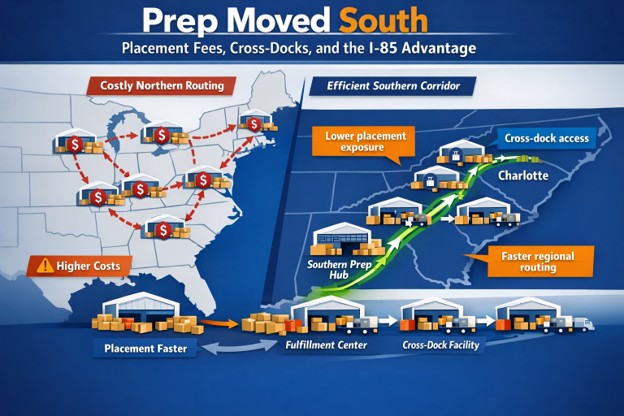
Here’s the sequence that traps people. A container lands. It goes to storage, or straight through to one FBA location because splitting it would mean handling every carton. The minimal-split fee gets paid — not chosen, just absorbed by default.
Now run it differently. The container gets opened somewhere that can prep and label every unit and rebuild it into several outbound shipments. Suddenly the cheaper placement option is available, because someone can actually execute it.
The difference isn’t sophistication. It’s whether there’s a floor, a crew, and a dock between the port and Amazon.
What Actually Sits on I-85
South Carolina built infrastructure for exactly this, and most sellers have never heard of it.
SC Ports operates Inland Port Greer, a rail-served intermodal terminal at exit 58 off I-85 in Upstate South Carolina. Norfolk Southern runs an overnight express shuttle between the Port of Charleston and Greer six days a week. Per SC Ports’ published schedule, a container clearing the Charleston cut-off at 1:00 PM Monday is available at Greer by 8:00 AM Tuesday. Gates run 24/7.
Read that as a prep timeline rather than a rail statistic. Your freight moves inland overnight, on rail, while you sleep — and arrives in a region where warehouse space and labor cost a fraction of what they do near the coastal ports or the western distribution hubs. Amazon’s placement fees also weight toward the West, where the network’s costs are highest.
Piedmont has operated in Spartanburg, on that same I-85 corridor, since 1975 — a couple of decades before anyone needed an FNSKU.
The Cross-Dock Math
Cross-docking is the piece that makes the fee math work. Inventory arrives, gets prepped, gets labeled, gets rebuilt into multiple outbound shipments, and leaves — without a storage cycle in between.
Stack that against the alternative and the ledger is straightforward. You avoid the minimal-split placement fee. You skip a storage leg. And you don’t pay the return freight on a shipment Amazon refuses, which in a year of elevated diesel is its own line item — the subject of Amazon’s 2026 Fee Stack: Why Prep Mistakes Cost More Than They Used To.
The catch is that cross-docking only works if prep is right the first time. There’s no second pass. Since Amazon stopped prepping and labeling units on January 1, and since resellers must now FNSKU every single unit, the volume of work sitting on that dock went up — and the tolerance for getting it wrong went to zero.
The Point
Every change this year pushed in the same direction. Amazon handed back prep. Amazon required more labeling. Amazon priced convenience and discounted distribution. Each one rewards having a capable building between your supplier and the fulfillment center.
Prep didn’t get harder in 2026. It got located.
Frequently Asked Questions
What are Amazon inbound placement fees?
The FBA inbound placement service fee is charged per unit based on how many receiving locations you ship your inventory to. Sending everything to a single location costs the most per unit; distributing across more locations reduces the fee, sometimes to zero.
Can I avoid inbound placement fees entirely?
Sometimes. Amazon states that lower-cost inbound shipment options are available as a way to reduce fees. Eligibility and rates depend on your product’s size tier, weight, and destination, so confirm current requirements in Seller Central.
Does where I prep affect my placement fees?
Indirectly, and significantly. The cheaper placement options require splitting inventory into multiple correctly-prepped shipments. If nobody in your chain can perform that split, the higher-fee option is your only practical choice.
What is Inland Port Greer?
A rail-served inland terminal operated by SC Ports at exit 58 off I-85 in Greer, South Carolina, connected to the Port of Charleston by Norfolk Southern overnight rail six days a week, with 24/7 gate access.
How fast can a container reach the Upstate from Charleston?
Per SC Ports’ published import schedule, a load meeting the 1:00 PM Charleston cut-off Monday through Thursday is available at Inland Port Greer at 8:00 AM the following morning.
About the Author
Ada Wallace is President of Piedmont Storage and Repack, LLC, operating as Piedmont Warehousing & Manufacturing Support in Spartanburg, South Carolina. She brings more than 24 years in the warehousing and manufacturing support industries and leads the second generation of Wallace family ownership of a business founded in 1975. Under her leadership, Piedmont holds ISO 9001:2015 certification and Women’s Business Enterprise (WBE) designation, serving clients across Spartanburg, Greenville, Anderson, Cherokee, Laurens, and Union counties. She can be reached at awallace@piedmontwarehousing.com.
Piedmont Warehousing & Manufacturing Support
Piedmont has run warehousing and manufacturing support from Spartanburg, South Carolina since 1975 — on the I-85 corridor, with cross-docking, barcode scanning, and prep under one roof. ISO 9001:2015 certified and woman-owned.
Our Services Include:
- Amazon Prep Services — FNSKU labeling, poly bagging, date labels, kitting, and multi-destination shipment builds
- Warehousing Services — Storage, cross-docking, and labeling in one Upstate facility
Paying a placement fee you didn’t choose? Contact Piedmont to talk through your inbound routing.
Works Cited
“2026 Updates to US Referral and Fulfillment by Amazon Fees.” Amazon Seller Central News and Announcements, Amazon.com Services LLC, sellercentral.amazon.com/seller-forums/discussions/t/f3fa3211-820b-4e2e-a023-158a9cf55f99. Accessed 16 July 2026.
“Inland Port Greer.” South Carolina Ports Authority, scspa.com/facilities/inland-port-greer/. Accessed 16 July 2026.