


Piedmont Warehousing & Manufacturing Support: A woman-owned, full-service warehousing and manufacturing support company exceeding expectations since 1975
U.S. retail e-commerce sales reached $340.2 billion in the second quarter of 2026, up 12.2 percent from the same quarter a year earlier, according to the U.S. Census Bureau’s Quarterly Retail E-Commerce Sales report released August 18, 2026. Total retail sales grew 6.7 percent over the same span. Online volume is pulling away from the rest of retail.
That growth lands on sellers differently than it used to. Amazon stopped performing FBA prep for U.S. sellers on January 1, 2026. Poly bagging, bubble wrapping, and FNSKU labeling became the seller’s job. Most sellers responded by hiring a prep center, and a lot of them picked whoever quoted the lowest per-unit rate.
The per-unit rate is the least useful number in the quote.
What a prep center is responsible for
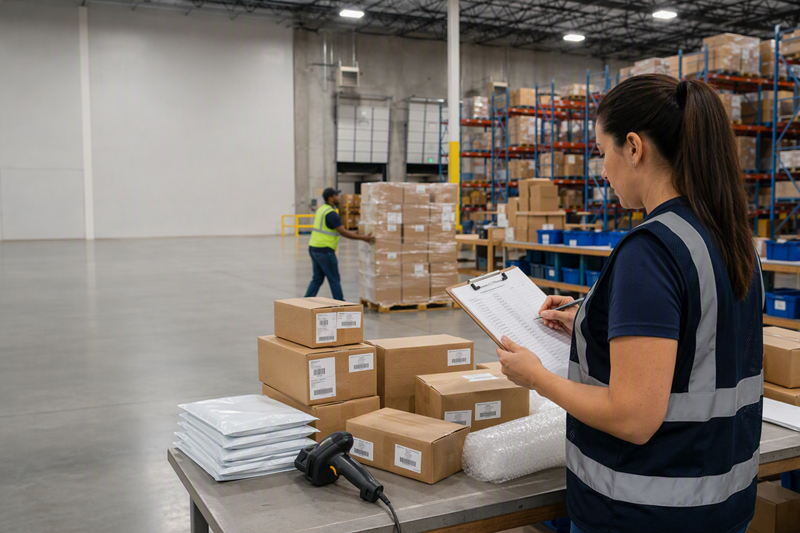
A prep center receives your freight, counts it, inspects it, applies the prep Amazon requires, builds the outbound shipment, and books the carrier. Each of those steps is a place where a unit can go wrong. Every one is also a place where a cheap operation quietly stops doing the work.
Counting is the clearest example. Some prep centers count cartons. Others open every carton and count units. The second costs more per unit and catches supplier shortages before Amazon does. Ask which one you are buying.
Four questions that separate prep centers
Ask who eats a defect. When a shipment arrives at a fulfillment center mislabeled, Amazon bills you, not your prep center. Find out in advance whether the provider credits the work, re-preps the units at its own cost, or shrugs. Put the answer in the agreement.
Ask for the receiving-to-shipment clock. Get a number in business days, not an adjective. That number decides whether you can restock inside a sales spike or watch a listing go out of stock while your inventory sits on a dock.
Ask what happens to a short or damaged carton. A prep center that photographs the discrepancy, emails you the same day, and holds the freight is doing inventory work. One that quietly ships what arrived is doing piece work.
Ask whether the operation runs a documented quality system. Certification is not a substitute for judgment, though it does tell you the provider has written procedures, trains against them, and gets audited by an outside party.
Where the quote hides money
A low per-unit headline rate rarely covers everything. Receiving, pallet storage, materials, shipment creation, carrier booking, and returns handling are often billed separately. Build a model using your real SKU mix and your real monthly volume, then ask each provider to price that model line by line.
Sellers still deciding whether to outsource at all should run the numbers on in-house prep against an outsourced per-unit rate before shopping quotes. Storage is the line that surprises people most. Prep centers hold your freight between receiving and outbound, and a provider with a slow turnaround charges you storage for its own delay. A faster operation can cost more per unit and less per month.
Capability breadth is a cost lever
Plenty of sellers need more than labeling. Multipacks need assembly. Damaged returns need rework before they can go back into a shipment. Retail-ready cases need shrink wrapping. A provider that handles only labeling sends that work somewhere else, and every extra handoff adds freight, time, and another chance to introduce an error.
Sellers moving into wholesale or retail distribution should weigh this harder. A provider already doing kitting and sub-assembly for manufacturers can usually absorb marketplace work without a new vendor relationship.
Check the requirements yourself
Prep requirements change, and a provider working from a 2024 checklist will get units rejected in 2026. Read Amazon’s FBA packaging and prep requirements in Seller Central before you sign anything, then ask the prep center to walk you through how it meets each category you sell. Suffocation warnings, expiration dating, and case-pack rules differ by product type.
Compliance with Amazon’s policies is your obligation as the seller of record. A prep center performs the work to your specification, so your specification has to be current.
Start with a paid test
Send one small shipment before you move your catalog. A structured prep center onboarding process turns that test into a working specification. Ask for photos at receiving, photos after prep, and the shipment plan before it goes out. Compare the invoice against the quote line by line. A provider that handles a 200-unit test cleanly will usually handle 20,000 units cleanly. One that cannot explain a small billing discrepancy is telling you something useful.
Piedmont Warehousing: Amazon Prep and Fulfillment in the Upstate
Piedmont Warehousing & Manufacturing Support is a woman-owned, ISO 9001:2015 certified 3PL in Spartanburg, South Carolina, serving the Upstate since 1975. Warehousing, fulfillment, and light manufacturing run under one roof on the I-85 corridor.
Our Services Include:
- Amazon Prep Services — FNSKU labeling, poly bagging, bubble wrapping, and inbound shipment preparation
- Pick & Pack — Order picking, packing, and outbound shipping for marketplace and direct channels
Evaluating prep centers on the I-85 corridor?
Contact Piedmont Warehousing to talk through volume, SKUs, and timing.
About the Author
Ada Wallace is President of Piedmont Storage and Repack, LLC, operating as Piedmont Warehousing & Manufacturing Support in Spartanburg, South Carolina. She brings more than 24 years in the warehousing and manufacturing support industries and leads the second generation of Wallace family ownership of a business founded in 1975. Under her leadership, Piedmont holds ISO 9001:2015 certification and Women’s Business Enterprise (WBE) designation, serving clients across Spartanburg, Greenville, Anderson, Cherokee, Laurens, and Union counties. She can be reached at awallace@piedmontwarehousing.com.
Works Cited
United States Census Bureau. “Quarterly Retail E-Commerce Sales: 2nd Quarter 2026.” Census.gov, U.S. Department of Commerce, 18 Aug. 2026, www.census.gov/retail/ecommerce.html.
Amazon. “FBA Packaging and Prep Requirements.” Amazon Seller Central, Amazon.com Services LLC, accessed 12 Sept. 2026, sellercentral.amazon.com/help/hub/reference/external/G201021850.
This article is general industry information and is not a substitute for current FDA guidance, Amazon’s published seller policies, or professional compliance advice for your specific products.