


Piedmont Warehousing & Manufacturing Support: A woman-owned, full-service warehousing and manufacturing support company exceeding expectations since 1975
Federal food labeling rules treat a variety pack as its own case. Under 21 CFR 101.9, a variety pack has to carry nutrition information for each variety per serving size. The rule covers packs of several single-serving varieties. It also covers products with separate compartments holding different foods. One combined panel for the whole box does not satisfy it.
That single rule reshapes a project plan. A variety pack is not a multipack with extra flavors. The label work scales with the number of varieties, and label work sits on the critical path.
Multipack and variety pack are different problems
A multipack holds several units of the identical item. Six of the same bar, four of the same bottle. The outer package describes one food.
A variety pack holds different items. Three flavors, four scents, a sampler of six. The outer package has to describe each of them.
Teams who plan a variety pack using multipack assumptions underestimate the artwork, the proofing cycle, and the component count. Every added variety brings another inbound component, another BOM line, and another block of label copy to verify.
Assembly complexity rises faster than variety count
A four-flavor pack is not four times harder than a one-flavor pack. It is harder than that, because the failure modes multiply.
A single-flavor multipack can be miscounted. Variety packs fail more ways. They can be miscounted, built out of sequence, built with a flavor substituted, or built with one doubled and another missing. An assembler looking at four similar pouches can transpose two without noticing.
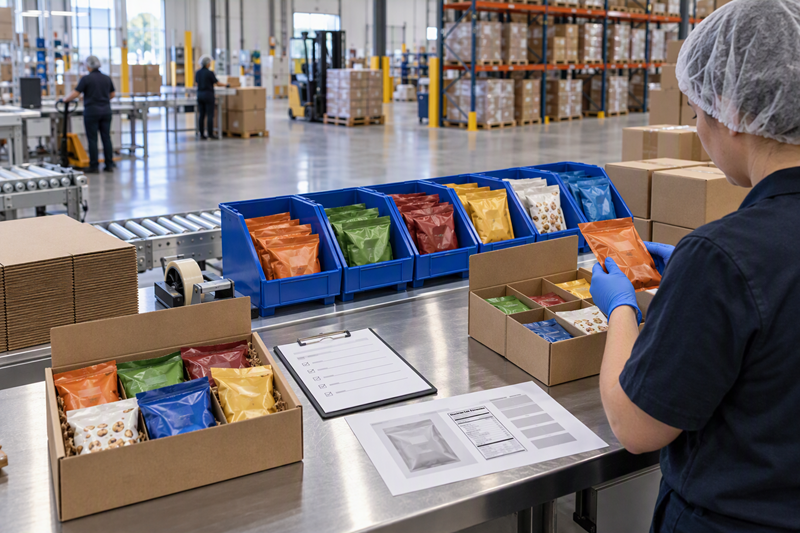
Pack stations have to be set up against this. Separate component bins, a fixed build sequence, and a verification step that checks composition rather than total count. A kit with the right count and the wrong mix can pass a weight check. It fails at the retailer.
What to settle before artwork goes to print
One item here comes from the regulation above. The rest are questions for whoever reviews your labels, because the answers turn on your product category.
Nutrition information per variety. This one is settled. Each variety in the pack carries its own figures, and a single combined panel does not satisfy the rule.
Identity and net quantity. What the finished pack is called, and how its total contents are declared. Neither carries over unchanged from a component label.
Ingredients and allergens. How each variety’s statement appears on a pack holding several different foods.
The pack’s own code. How the finished pack is identified and scanned, separately from the units inside it.
Category-specific rules. Dietary supplements, non-food goods, and foods overseen by other agencies follow different requirements.
Read the regulations that govern your product. Confirm the finished label with your own regulatory counsel before anything prints.
Compliance is the brand owner’s obligation
The company whose name is on the package answers for what the package says. A kitting operation builds to your specification and applies the labels you supply. It is not the author of your label copy. No assembly provider can take that obligation on your behalf.
What a provider can do is hold the line on execution. Correct label, correct panel, correct orientation, correct pack, every unit. That requires an approved artwork proof, a documented build standard, and inspection against both.
Sequence the project backward from the label
Artwork and regulatory review usually take longer than assembly. Teams who start with the pack configuration and leave labeling for later risk losing weeks at the end.
A workable order runs the other way. Lock the assortment. Draft the label copy for every variety. Complete regulatory review. Approve the artwork and print. Only then schedule the build.
Locking the assortment early matters for a second reason. Changing a component after the fact creates a different product, with its own identifier and artwork. A late swap is not an edit. It is a new item.
Before the first unit ships
Build a sample pack. Put it in front of whoever signs off on compliance. Check the panel against the regulation and the components against the bill of materials. Confirm finished dimensions against the retailer’s spec.
Then decide how the program will run. Pre-building against build-to-order determines how much labeled packaging you commit up front.
Piedmont Warehousing: Variety Packs and Kitting in Upstate South Carolina
Piedmont Warehousing & Manufacturing Support is a woman-owned, ISO 9001:2015 certified 3PL in Spartanburg, South Carolina, serving the Upstate since 1975. Warehousing, fulfillment, and light manufacturing run under one roof on the I-85 corridor.
Our Services Include:
- Kitting Services — Component assembly, bundling, and ready-to-ship kit production
- Value/Variety Packs — Multi-product samplers, promotional bundles, and mix-and-match sets
Building a retail variety pack this season? Contact Piedmont Warehousing to talk through components, volumes, and timing.
About the Author
Ada Wallace is President of Piedmont Storage and Repack, LLC, operating as Piedmont Warehousing & Manufacturing Support in Spartanburg, South Carolina. She brings more than 24 years in the warehousing and manufacturing support industries and leads the second generation of Wallace family ownership of a business founded in 1975. Under her leadership, Piedmont holds ISO 9001:2015 certification and Women’s Business Enterprise (WBE) designation, serving clients across Spartanburg, Greenville, Anderson, Cherokee, Laurens, and Union counties. She can be reached at awallace@piedmontwarehousing.com.
Works Cited
United States Food and Drug Administration. “21 CFR 101.9 — Nutrition Labeling of Food.” Electronic Code of Federal Regulations, Office of the Federal Register, accessed 10 Oct. 2026, www.ecfr.gov/current/title-21/chapter-I/subchapter-B/part-101/subpart-A/section-101.9.
This article is general industry information and is not a substitute for current FDA guidance, your product’s governing regulations, or professional compliance advice for your specific products.