


Piedmont Warehousing & Manufacturing Support: A woman-owned, full-service warehousing and manufacturing support company exceeding expectations since 1975
Prices for processed goods used as production inputs rose 1.8 percent in August 2026. That left them 11.5 percent above a year earlier. Paperboard turns up elsewhere in the same release, among the commodities lifting the stage 2 intermediate demand index. All of it comes from the Producer Price Index release the Bureau of Labor Statistics published on September 10, 2026.
Cartons, trays, film, and inserts are the inputs a kitting program consumes. When those prices move that fast, the timing of converting components into finished kits stops being a detail.
The two models
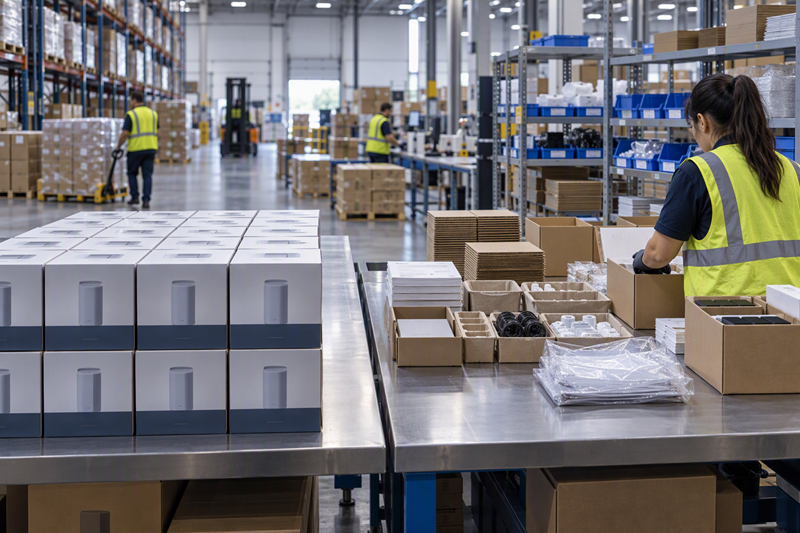
Pre-building means assembling kits ahead of demand and holding them as finished goods. Orders ship from a shelf of completed units.
Build-to-order means holding components loose and assembling only against a confirmed order or a scheduled release.
Both produce the same kit. They commit your money at different moments, and that is the whole argument.
What pre-building buys and costs
Speed is the gain. A finished kit picks and ships like any other item, so a retailer order placed Monday can leave Tuesday. Peak season is where this pays. A program moving high volume inside a short window will struggle to assemble each unit on demand.
Throughput is the second gain. Running one long build in a single setup is usually cheaper per unit than restarting a station every few days.
The cost is commitment. A pre-built kit is locked. Changing the assortment means breaking kits down and rebuilding them. That labor usually runs higher than the original build. Rising material prices make the mistake worse. You spent on cartons and film before knowing whether the configuration would sell.
Pre-built kits also consume more space. Three components in bulk cartons take less room than the same three sealed into a presentation box.
What build-to-order buys and costs
Flexibility is the gain. Components stay sellable in other configurations. A loose unit can go into a two-pack, a three-pack, a retail case, or out the door alone.
Risk drops with it. You are not holding a dead assortment if a promotion underperforms.
The cost is time and unit price. Assembly happens inside the order cycle, so lead time is longer. Short runs mean repeated setup, and setup is the expensive part of kitting.
Build-to-order also strains forecasting. Components have to be on hand in the right ratios. A shortage of one item stops every kit it belongs to.
How to choose
Ask four questions.
Is the assortment settled? A fixed, repeating configuration tolerates pre-building. One still being negotiated with a buyer does not.
How long is the selling window? Short promotional windows with hard retailer dates favor pre-building. Steady year-round demand tolerates building on a schedule.
What is the component shelf life? Dated goods inside a sealed kit start burning clock on the build date, not the ship date.
What happens if it does not sell? If the answer is reverse kitting, price that work before committing to a pre-build.
Most programs end up split
The useful answer is rarely one model for everything. Teams often pre-build a base quantity sized to committed orders, then hold components to build the rest on demand.
That approach caps the downside. The committed volume gets the throughput advantage of a long run. Everything speculative stays flexible, and unsold components go back into normal stock rather than into a teardown queue.
Set the base quantity against firm purchase orders, not against a forecast. A forecast is a reason to hold components, not a reason to seal them into cartons.
Either way, the specification comes first
Both models run on the same document. Every bundle you build is a new SKU with its own identifier and bill of materials. The model you pick does not change that.
Material prices argue for deciding deliberately rather than by default. Converting components into finished kits is a purchase, and the invoice shows up in both cartons and labor. Brands building retail assortments should settle what the finished pack carries on its label. Do that before either model produces units.
Piedmont Warehousing: Kitting and Sub-Assembly in Spartanburg
Piedmont Warehousing & Manufacturing Support is a woman-owned, ISO 9001:2015 certified 3PL in Spartanburg, South Carolina, serving the Upstate since 1975. Warehousing, fulfillment, and light manufacturing run under one roof on the I-85 corridor.
Our Services Include:
- Kitting Services — Component assembly, bundling, and ready-to-ship kit production
- Sub Assembly — Component integration and kit building for production lines
Deciding how to run your kitting program? Contact Piedmont Warehousing to talk through components, volumes, and timing.
About the Author
Ada Wallace is President of Piedmont Storage and Repack, LLC, operating as Piedmont Warehousing & Manufacturing Support in Spartanburg, South Carolina. She brings more than 24 years in the warehousing and manufacturing support industries and leads the second generation of Wallace family ownership of a business founded in 1975. Under her leadership, Piedmont holds ISO 9001:2015 certification and Women’s Business Enterprise (WBE) designation, serving clients across Spartanburg, Greenville, Anderson, Cherokee, Laurens, and Union counties. She can be reached at awallace@piedmontwarehousing.com.
Works Cited
United States Bureau of Labor Statistics. “Producer Price Indexes — August 2026.” BLS.gov, U.S. Department of Labor, 10 Sept. 2026, www.bls.gov/news.release/ppi.nr0.htm.