


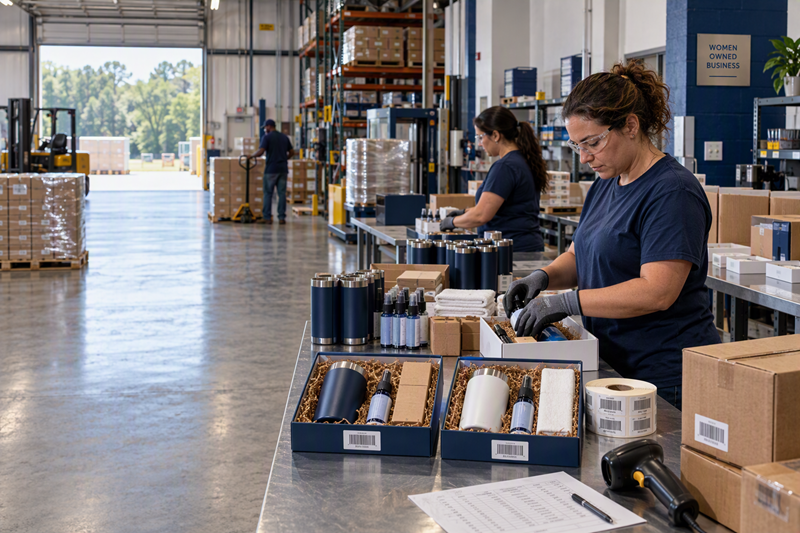
Piedmont Warehousing & Manufacturing Support: A woman-owned, full-service warehousing and manufacturing support company exceeding expectations since 1975
GS1 is the organization behind the barcode. Its word for a bundle is predefined assortment: two or more trade items sold as one. The GTIN Management Standard states that changing, adding, or replacing any item inside that assortment requires a new GTIN. Individual items keep their own numbers, separate from the number on the bundle.
Read that twice before you plan a kitting program.
A kit is a product, not a packing step
Most people treat kitting as something that happens to products. Bagging, boxing, taping. The standard says otherwise. Combine two items, sell them as one, and you have created a third product.
That third product needs its own number, label, carton, dimensions, and weight. It needs a place in your item master and a shipping cost of its own. A two-flavor sampler and a three-flavor sampler are two products, not one product with options.
Changing a component creates another product
This is the part that catches brands mid-program. Swap one scent in a three-piece gift set and the standard calls for a new GTIN on the set. Replace a blue shirt in a multipack with a yellow one and the same rule applies. The set changed, so the set is new.
Brands who skip this end up with one barcode covering two different physical products. Retail systems have no way to tell them apart. Returns get credited against the wrong item. Sales data for the old configuration and the new one pile into a single line.
What a kitting operation actually needs from you
A provider cannot build a kit from a conversation. The work runs on a documented bill of materials. That document separates a program that holds from one that drifts.
A component list with identifiers. Every item in the kit, named and numbered, with the quantity of each.
A build sequence. Orientation, placement, which insert goes where, which way the label faces. Two assemblers should produce identical kits.
A finished-kit specification. Outer carton, barcode placement, case pack, pallet pattern, and the weight and dimensions the kit ships at.
A version number. When the assortment changes, the BOM changes. Both versions need to exist in the record.
Where kits break
Component shortages cause most of it. A supplier ships 900 of one item against 1,000 of the others. Somebody on the floor then decides whether to build 900 kits or substitute. That decision belongs to you, in writing, before it comes up at 2 p.m. on a Thursday.
Quality is the other failure point. A kit is only as good as its weakest component. Defects caught easily on a single-item line disappear inside a sealed multipack. Inspection has to happen at the component stage, before anything gets sealed.
Reverse kitting matters too. Programs end. Promotional sets come back. Somebody has to break those kits down and return components to sellable stock. That work needs a plan from the start.
Who this applies to
Manufacturers building production-ready component kits for a line. Brands launching a retail multipack. E-commerce sellers assembling gift sets and subscription boxes. Promotional programs that run for one quarter and then stop.
Products differ. The discipline does not. Each creates a new item: identified, built the same way every time, tracked on its own.
Teams weighing how to run the program should look at whether to pre-build kits or assemble on demand. That choice shapes cost and lead time more than anything else in the project.
Start with the bill of materials
Before you price a kitting program, write the BOM. List the components, the quantities, the build sequence, and what happens when one component runs short.
A provider who asks for that document on the first call is treating your kit as a product. One who quotes a per-unit rate without it is quoting on a guess. Brands building retail assortments should also settle what the finished multipack carries on its label. Do that before artwork goes to print.
Piedmont Warehousing: Kitting and Contract Packaging in the Upstate
Piedmont Warehousing & Manufacturing Support is a woman-owned, ISO 9001:2015 certified 3PL in Spartanburg, South Carolina, serving the Upstate since 1975. Warehousing, fulfillment, and light manufacturing run under one roof on the I-85 corridor.
Our Services Include:
- Kitting Services — Component assembly, bundling, and ready-to-ship kit production
- Contract Packaging — Shrink wrapping, bagging, sealing, labeling, and retail-ready packaging
Planning a kitting program in Upstate South Carolina? Contact Piedmont Warehousing to talk through components, volumes, and timing.
About the Author
Ada Wallace is President of Piedmont Storage and Repack, LLC, operating as Piedmont Warehousing & Manufacturing Support in Spartanburg, South Carolina. She brings more than 24 years in the warehousing and manufacturing support industries and leads the second generation of Wallace family ownership of a business founded in 1975. Under her leadership, Piedmont holds ISO 9001:2015 certification and Women’s Business Enterprise (WBE) designation, serving clients across Spartanburg, Greenville, Anderson, Cherokee, Laurens, and Union counties. She can be reached at awallace@piedmontwarehousing.com.
Works Cited
GS1. “Predefined Assortment.” GTIN Management Rules, GTIN Decision-Support Tool, GS1 AISBL, accessed 10 Oct. 2026, gs1.org/en/standards/id-keys/gtin/gtin-decision-support-tool/predefined-assortment.